Whulonians
The Last of the MohicansThe Hurons, also called the Wyandots, are a French-aligned Indigenous people whose changing fortunes make them both a military force and a political community in the novel. They shelter Magua’s ambitions, pursue those who escape their custody, and ultimately face defeat when the Delawares attack their village. Their story is presented through a tension between sweeping descriptions of Indigenous customs and particular scenes of deliberation, persuasion, and collective action.
Identity and Political Position
The narrative identifies Magua as a Huron by birth, though he had been adopted by the Mohawks and served alongside them before becoming a guide to the English party. Duncan Heyward recounts that Magua’s earlier arrival among the English followed an incident involving Colonel Munro, but dismisses the story as an idle tale. Hawkeye, by contrast, responds to Magua’s Huron identity with open distrust, describing the people through a prejudicial stereotype; Heyward points out that their guide is then serving the English as a friend. This exchange establishes how ethnic labels shape judgments even when an individual’s immediate allegiance appears to contradict them.
The Hurons are aligned with the French, and the narrator explains that the tribes friendly to France felt little immediate danger from Indigenous nations tributary to the British Crown. That confidence changes after the fighting and later escapes make the Huron community vulnerable. Their position is not simply a fixed alliance: it is shaped by military pressure, colonial power, and the choices of leaders seeking to preserve influence and security.
Council, Persuasion, and Collective Memory
The Hurons’ political life is repeatedly shown through public speech and collective response. Magua’s standing among them has suffered because of his weakness and his earlier desertion, but his courage and reputation as an orator remain powerful. When he addresses the community, he draws on the memory of fallen warriors, arguing that they have departed without the equipment and provisions due to them. His appeal turns grief into a demand for retaliation against Uncas, and the tribe’s response shows how remembered injury and obligations to the dead can become immediate political force.
After the escape from the cavern, the Huron fighting men gather around the council lodge and seek direction. Magua is summoned because his counsel is needed. He then reports what happened without concealment, exposing the deception practiced by Duncan Heyward and Hawkeye; the assembled warriors recognize that they have been deliberately misled. In a later address, Magua first praises Huron courage and wisdom, then argues that discretion is necessary because the French governor has become displeased while a larger opposing population poses another danger. His words help organize a group of twenty warriors, armed for war but wearing peaceful paint, who assemble at his hut before dawn. The episodes show persuasion as more than personal eloquence: speeches interpret collective experience and direct action.
Military Action and Defeat
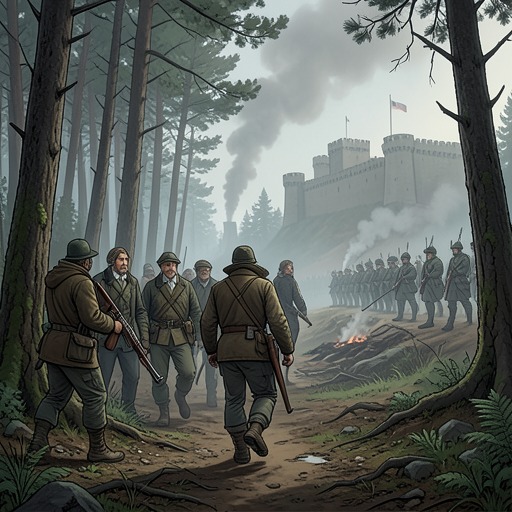
The Hurons are active pursuers and defenders, but their military fortunes shift as the conflict widens. A party escaping into the forest comes under rifle fire, and a Delaware is killed. The attackers are soon drawn toward the village as Uncas’s force presses forward; the Huron line breaks, and its warriors retreat into the woods under pursuit by the victorious Lenape. Magua remains conspicuous among a small group withdrawing up the slope, maintaining an air of authority even as the larger force is driven back.
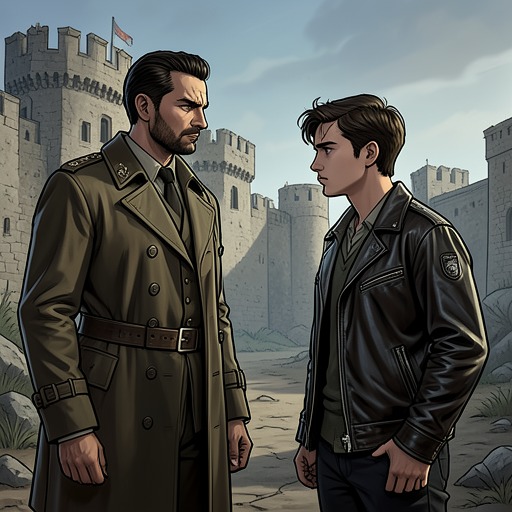
Uncas continues the pursuit despite Hawkeye’s call to use cover, and the opposing parties reach the Wyandot village close together. There, Uncas confronts Magua directly. These scenes lead into the destruction of the Huron community: the people who had gathered, debated, and fought are also a community overtaken by the consequences of the larger conflict and the Delawares’ attack.
Narrative Representation and Significance
The novel grants the Hurons political agency through their councils, military decisions, and responses to public argument, yet often filters them through broad descriptions that treat Indigenous custom as uniform. The contrast is visible in the narration itself: it generalizes about the absence of armed guards at Indigenous camps, while the specific scenes show a community assembling, evaluating events, and choosing a course under pressure. Magua’s speeches likewise give voice to Huron memory and political calculation, even as the narrator frames his influence through the language of cunning and revenge.
The Hurons’ trajectory therefore connects individual ambition with collective vulnerability. Their actions cannot be reduced to Magua’s decisions alone: warriors gather in council, respond to the death of their companions, and fight to defend their village. Their defeat closes a major strand of the novel’s conflict, while the gap between their depicted political life and the narrative’s generalizing vocabulary remains central to how the community is represented.